Dissolving an Eggshell in Vinegar, Gram by Gram
A chicken eggshell is about 5 g of calcium carbonate wrapped around a membrane. Vinegar takes the mineral and leaves the membrane, which is how you end up with a rubbery egg and a measurable mass loss.
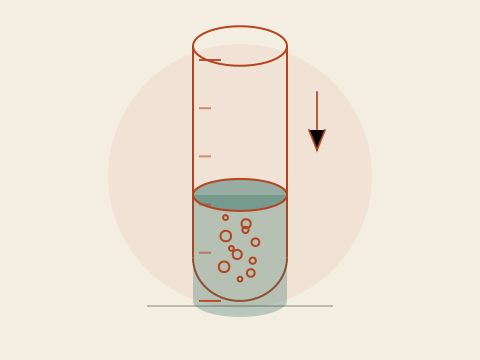
Materials
| Item | Amount | If you do not have it |
|---|---|---|
| Raw chicken eggs | 2, room temperature | Duck eggs are larger and take about 12 hours longer |
| White vinegar, 5% acetic acid | 500 ml | Any clear 5% vinegar; darker vinegars hide the bubble layer |
| Tall glass jar | 1, wide enough for the egg to sit clear of the walls | A plastic tub, but glass shows the bubbles better |
| Kitchen scale | 1, accurate to 0.1 g | 0.5 g accuracy is enough for the shell mass |
| Soft toothbrush | 1, optional | A cotton bud for the last patches |
| Lid or cling film | 1 | A saucer balanced on top |
Method
Weigh both eggs dry and record the masses. A medium hen egg is usually 58 to 62 g.
Watch for: The two eggs will differ by a gram or two even from the same box.
Lower the eggs into the jar and pour in enough vinegar to cover them by 3 cm. Cover the jar loosely.
Watch for: Within seconds a dense coat of fine bubbles forms on the shell and the eggs start to rotate slowly as bubbles detach unevenly.
Leave for 12 hours. Then pour off the cloudy liquid and add fresh vinegar.
Watch for: The liquid is milky because the calcium carbonate has become dissolved calcium acetate, and a white scum floats on top.
After another 12 hours, rub the egg gently under running water with the toothbrush to lift the last chalky patches.
Watch for: The shell comes away as a soft white paste; underneath, the egg feels like a water balloon with no rigidity at all.
Blot the bare egg dry and weigh it again. Compare with the starting mass.
Watch for: Each egg has lost 5 to 7 g, and about a gram of that is water that moved into the egg rather than shell that dissolved.
Why it works
Eggshell is 94 to 97 percent calcium carbonate by mass, laid down as calcite crystals interlocked with a small amount of protein. Acetic acid attacks the calcite and converts it into calcium acetate, which is soluble, plus carbon dioxide and water. Once the mineral is gone, the only thing holding the egg together is the shell membrane, a two-layer protein sheet a few micrometres thick. Because that membrane is semi-permeable, the egg also gains a little water from the vinegar, which is why the mass loss you measure is slightly less than the true shell mass. The egg is not rubber: it is a filled membrane bag with no structural support, which behaves elastically under small loads.
Think of it like: The shell is like plaster over brickwork. Vinegar dissolves the plaster, and what is left is the coat of paint that was stretched over it -- flexible, watertight, and with nothing solid to hold it up.
Clean-up and disposal
Discard the spent vinegar; it is dilute calcium acetate and safe for the drain with plenty of water. The naked egg must be kept in the fridge in fresh water if you want to keep it overnight, and it becomes fragile after about 48 hours as the membrane weakens. Wash your hands after handling raw eggs.
Bench notes
Why two soaks
One soak stalls. After about six hours the liquid next to the shell is saturated enough with calcium acetate that the reaction slows to almost nothing, and the egg acquires a chalky skin that does not rinse off.
Observed / 实测A medium egg loses 3.8 to 4.2 g in the first five hours, and only about 1.5 g more over the following nineteen hours.
Handling a shell-less egg
It is much tougher than it looks and much weaker than it feels. It survives a drop of ten centimetres onto a wet cloth and will not survive being picked up with dry fingers.
Observed / 实测A bare egg is about 8 percent heavier than the same egg without its shell would be, because of the water it has taken in.
The smell and the mess
Variations worth running
- Weigh the egg every two hours for the first eight hours and plot the mass curve. Most of the shell mass is gone in the first four hours.
- Compare a bare egg left in tap water with one left in golden syrup for 24 hours: syrup draws water out and the egg shrivels.
- Add three drops of food colouring to the second vinegar soak and see whether the membrane takes up the dye evenly.
Questions that come up on the bench
- Why does the egg grow slightly as the shell disappears?
- The membrane is semi-permeable and the vinegar is mostly water with a low dissolved-solids content, so water moves into the egg by osmosis. The egg also swells because the shell is no longer there to hold its shape.
- Can I still eat it?
- No. The membrane has been sitting in dilute acid for a day at room temperature, and the raw egg inside is a bacterial risk even when refrigerated. This is a bench demonstration, not a recipe.
- Does the type of vinegar matter?
- Only the acetic acid strength matters. Cider and malt vinegars work at the same rate but their colouring compounds stain the membrane and make it harder to see the shell come away cleanly.