Rock Candy: Growing Sugar Crystals on a Seeded Stick
A saturated sugar solution left to cool slowly gives up its excess sugar as crystals, and if you give it a seed to grow on, you get one large clear mass instead of a jar of sludge. The whole trick is controlling how fast it cools.
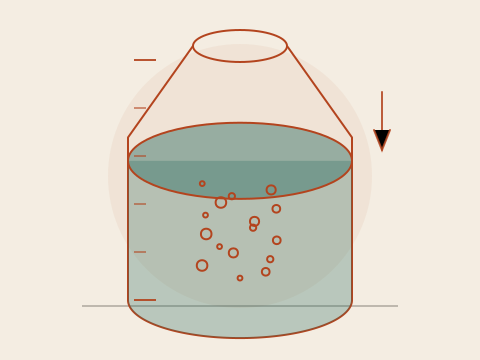
Materials
| Item | Amount | If you do not have it |
|---|---|---|
| White granulated sugar | 900 g | Caster sugar dissolves faster but gives smaller crystals |
| Water | 300 ml | Filtered water; hard water adds mineral haze |
| Tall glass jar | 1, 500 ml | A heatproof measuring jug |
| Wooden skewers or clean string | 3 | Bamboo skewers, boiled for five minutes to clean them |
| Extra sugar for seeding | 30 g | None; an unseeded stick grows almost nothing in the first day |
| Peg, clip or spoon | 1 | Anything that holds the skewer off the bottom of the jar |
Method
Bring 300 ml of water to a boil, then stir in the sugar 100 g at a time until no more will dissolve.
Watch for: The last 100 g takes about four minutes of stirring; the syrup turns faintly cloudy and then clears.
Roll the skewers in a shallow dish of extra sugar and let them dry for ten minutes so they have a rough coat.
Watch for: The sugar grains stick to the damp wood and give the syrup thousands of nucleation points.
Pour the hot syrup into the jar. Lower a skewer in so it hangs at least 2 cm clear of the bottom and the sides.
Watch for: Crystals start appearing on the coated skewer within twenty minutes as a fine white frost.
Cover the jar with a cloth and leave it somewhere it will not be moved. Do not put it in the fridge.
Watch for: Slow cooling over 24 hours is what makes large crystals; a fridge gives you thousands of tiny ones.
After 5 to 7 days, lift the skewer out and hang it over a plate to dry for two hours.
Watch for: The mass is a cluster of clear, faceted crystals 8 to 15 mm across, hardest and clearest at the top of the stick.
Why it works
Solubility of sucrose in water rises steeply with temperature: about 200 g dissolves in 100 ml at 20 C but over 490 g at 100 C. Boiling therefore dissolves far more sugar than the water can hold at room temperature, producing a supersaturated solution. As the syrup cools it must shed the excess, and it can either crystallise or stay metastable. Crystallisation needs a nucleation site disfavoured by energy, so a rough seed coat lets each grain start a crystal. Growth rate then depends on how quickly sugar molecules can reach the surface, which is why slower cooling and no disturbance give fewer, larger crystals -- the same total sugar divided among fewer seeds.
Think of it like: Crystals are like a queue forming at a ticket window. One window with a slow, orderly line gives you a long orderly queue. Twenty windows all opening at once give you twenty short messy ones. Same number of people, different outcome.
Clean-up and disposal
The syrup left in the jar is edible sugar solution and can be poured down the sink with hot water, or boiled down and used in coffee. Wash the jar with hot water before the syrup sets. Skewers can be rinsed, dried and reused once they have been boiled again.
Bench notes
Saturation before beauty
If you get the saturation point wrong nothing else matters. Weigh the sugar rather than scooping it, because a cup of granulated sugar varies by up to 40 g depending on how it was packed.
Observed / 实测At 20 C, 300 ml of water holds about 600 g of sucrose. Starting with 900 g means about 300 g is available to crystallise, which is enough for a 100 g candy stick plus a good deal of waste.
Slow is the whole variable
Observed / 实测A jar wrapped in a towel and left in a 20 C room cools to room temperature in about nine hours. The same jar on a bare countertop takes four hours and gives crystals roughly half the size.
Days five to seven
Observed / 实测Crystal mass grows by about 0.8 g per day per skewer in the first five days and then slows sharply as the syrup becomes dilute enough that it is no longer supersaturated.
Variations worth running
- Set one jar on a folded towel to cool very slowly and one on a metal tray to cool fast, and compare crystal size after three days.
- Add a drop of food colouring or a teaspoon of lemon juice to one jar; acid inverts some sucrose to glucose and fructose and changes the crystal habit.
- Use a length of cotton thread weighed down with a clean metal nut instead of a skewer and see whether the thread or the stick grows bigger crystals.
Questions that come up on the bench
- Why did my crystals form on the bottom instead of the stick?
- The jar was disturbed or cooled too fast, so spontaneous nucleation in the bulk liquid beat growth on the seed. Keep the jar still, wrap it in a towel, and make sure the stick is not touching the bottom or the sides.
- How do I know the solution was saturated?
- A few undissolved grains should remain at the bottom after stirring for a minute. If everything dissolved, there is not enough excess sugar to grow a visible crystal.
- Why does the candy taste less sweet than the syrup?
- It is the same sucrose, but crystal size changes how fast it dissolves in your mouth. A large crystal releases sugar slowly, so the sweetness arrives later and feels weaker.