Mentos in Diet Cola: Counting Nucleation Sites
The geyser is not a chemical reaction. It is carbon dioxide coming out of solution all at once because the sweet surface of a mint gives the gas somewhere to form bubbles. The variable you can actually test is the surface, not the cola.
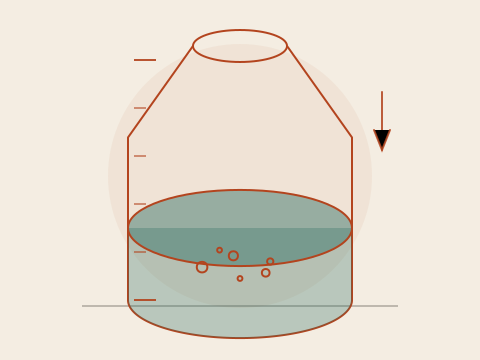
Materials
| Item | Amount | If you do not have it |
|---|---|---|
| Diet cola, 500 ml bottle | 3 bottles, chilled to 4 C | Any carbonated drink; sugary cola is stickier but no faster |
| Mint Mentos | 1 roll per test | Any hard mint with a pitted sugar surface |
| Fruit Mentos | 1 roll | Waxier hard sweets for the comparison |
| Outdoor space or a bathtub | 1 | A large bin lined with a bag |
| Drinking straw | 1 | A short length of PVC pipe |
| Tape measure | 1 | A wall with marks at known heights |
Method
Chill all three bottles to 4 C overnight. Cold liquid holds more dissolved carbon dioxide than warm.
Watch for: A bottle taken straight from the fridge barely hisses when you crack the cap.
Stand a bottle on level ground outside and drop five mint Mentos in at once. Step back immediately.
Watch for: The column reaches 4 to 6 metres and the whole bottle empties in about two seconds.
Repeat with five fruit Mentos and measure the peak height.
Watch for: Fruit Mentos give a column roughly one third as high because their surface is smoother and waxier.
For the third bottle, tape the straw to the neck and blow gently into the cola for ten seconds first.
Watch for: This pre-seeds bubbles on the glass wall, and the later geyser is noticeably weaker.
Now run a control: shake a fourth bottle hard with no sweet added and measure the height.
Watch for: Shaking alone gives about 1 metre, which shows how much of the effect is surface rather than agitation.
Why it works
A carbonated drink is a supersaturated solution of carbon dioxide held at about three volumes of gas per volume of liquid. It stays supersaturated because forming a new bubble inside the bulk liquid costs a great deal of surface energy. Mint Mentos have a surface covered in microscopic pits, a few micrometres across, which trap air when they enter the liquid. Those trapped air pockets are ready-made bubbles, so carbon dioxide can leave solution into them without paying the nucleation cost. Each sweet delivers thousands of nucleation sites at once, and the gas that escapes pushes liquid out of the neck. Surface roughness is the whole mechanism, which is why fruit Mentos and a pre-seeded bottle both give much smaller geysers.
Think of it like: Boiling a kettle needs a scratch on the element to start. Perfectly smooth surfaces can hold water above its boiling point for a moment because there is nowhere for the first bubble to form. The mint is that scratch, delivered thousands of times per second.
Clean-up and disposal
Do this outdoors or in a bathtub. Cola spray on concrete leaves a sticky film that attracts ants; rinse with a hose immediately. Do not pour the leftover cola onto a lawn, because the sugar and acid kill grass. Wipe the bottle caps and recycle the bottles.
Bench notes
Temperature is a hidden variable
A cold bottle holds more gas, so it makes a bigger geyser. Letting all three bottles reach room temperature before testing removes that variable and drops the peak height by about 30 percent.
Observed / 实测At 4 C the peak is 4.5 to 6 m. At 22 C the same setup peaks at 3 to 4 m.
Counting what you cannot see
You cannot count nucleation sites directly, but you can count bubbles. Film a single sweet in a glass at 240 frames per second and the bubble streams leaving the surface are individually separable.
Observed / 实测A single mint sweet in still cola produces visible bubble streams from roughly 30 distinct patches on its surface within the first second.
Outdoor only
Variations worth running
- Compare one, three and five sweets in the same bottle size and plot peak height against the number of sweets.
- Try a boiled sweet that has been rolled in fine sugar versus one wiped smooth with a damp cloth.
- Drop a single sweet into a glass of cola and film it in slow motion to see the bubble streams leaving each pit.
Questions that come up on the bench
- Does the cola have to be diet?
- No. Diet cola is used because it is less sticky to clean up and does not attract wasps. Sugary cola gives a slightly more vigorous geyser mainly because its higher viscosity keeps the foam together for a moment longer.
- Why does shaking the bottle beforehand make the geyser weaker?
- Shaking releases a large part of the dissolved gas before the sweets go in, and it also leaves a foam layer on the surface that lets the remaining gas escape gradually rather than all at once.
- Is this dangerous?
- A 500 ml bottle produces a two-second jet of sticky liquid at low pressure. It will not injure you, but it will ruin clothing and sting if it hits your eyes. Keep the bottle upright, never point it at anyone, and never use a glass bottle.