Stacking Five Liquids: A Density Column You Can Drink
Honey, syrup, water, oil and alcohol stack in a tall glass in a fixed order and stay that way for hours. Weigh equal volumes of each first and you can predict the order before you pour a single drop.
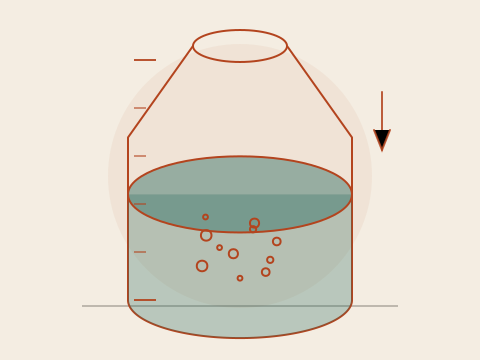
Materials
| Item | Amount | If you do not have it |
|---|---|---|
| Honey | 60 ml | Golden syrup, which is denser still |
| Maple syrup | 60 ml | Agave syrup or corn syrup |
| Water with 20 g of sugar dissolved in 60 ml | 60 ml | Full-sugar cola, flat |
| Sunflower or vegetable oil | 60 ml | Any neutral cooking oil; olive oil is slightly denser |
| High-strength clear spirit, 40% or more | 60 ml | Rubbing alcohol, which must not be tasted |
| Tall narrow glass | 1, at least 250 ml | A bud vase or a graduated cylinder |
Method
Weigh 60 ml of each liquid in the same small cup, rinsing and drying between them, and write down each mass.
Watch for: Honey comes in around 85 g, syrup 80 g, sugared water 66 g, oil 55 g and spirit 57 g per 60 ml.
Rank the five liquids by mass per unit volume before you pour anything.
Watch for: Oil and spirit are close enough that the order between them depends on the exact proof of the spirit.
Pour 60 ml of honey into the tall glass and let it settle flat.
Watch for: Honey takes about a minute to level out because its viscosity is thousands of times that of water.
Add each subsequent liquid by pouring it slowly down the side of the glass, densest first.
Watch for: Each layer sits on the one below with a crisp interface. The oil and spirit layers are the only pair that shows any mixing.
Leave the glass on the bench for an hour, then look at the interfaces again.
Watch for: The sharp boundaries soften as the two least viscous layers slowly diffuse into each other.
Why it works
Density is mass per unit volume, so a liquid floats on any liquid denser than itself. Honey is mostly fructose and glucose with very little water and comes in at about 1.42 g/ml; maple syrup at 1.33; sugar solution at 1.10; oil at 0.92; and 40 percent spirit at about 0.95. The layers stay put because the denser liquid below cannot rise through the lighter one above it without displacing it, and viscosity slows the mixing that would eventually even things out. The interface stays sharp because the two liquids at a boundary do not mix chemically: sugar water and oil are immiscible, and honey and syrup differ mainly in how much water they hold rather than in what kind of molecule they are made of.
Think of it like: A density column is a queue sorted by weight rather than by arrival. Every liquid sits on whichever liquid is heavier than it and under whichever is lighter, and it has no reason to move once it is in the right place.
Clean-up and disposal
This column is food, so the safest end is to pour the top two layers off and discard them if any non-food alcohol was used, then eat the rest. If you used rubbing alcohol, tip the whole glass into a sealed container and take it to a household chemical collection point. Never pour isopropyl alcohol down the sink in quantity.
Bench notes
Weighing before pouring
The point of this bench card is that you predict the stack from the balance, not discover it by pouring. Weighing 60 ml of each takes six minutes and removes all the guesswork.
Observed / 实测The difference between the two lightest layers is only about 0.03 g/ml, which is inside the error of a 1 g kitchen scale. Use 200 ml samples if you want to separate them confidently.
What the interfaces look like
With patience you get five clean boundaries. The one between the sugared water and the oil is the most useful teaching moment, because it is the boundary where the two liquids genuinely do not mix at all.
Observed / 实测A single drop of oil released under the sugared water rises through it and stops dead at the syrup boundary.
Alcohol on the bench
Variations worth running
- Add a sixth layer of glycerine, density 1.26, and predict where it lands before you pour.
- Drop in a cherry tomato, a grape, a piece of carrot and a plastic bead and predict which layer each stops at.
- Warm the whole glass in a 40 C water bath for ten minutes and watch the boundaries move as viscosity drops.
Questions that come up on the bench
- Why do oil and spirit sometimes swap places?
- Density depends on the exact alcohol concentration. A 40 percent spirit is about 0.95 g/ml, which is denser than sunflower oil at 0.92, but a 50 percent spirit falls to about 0.93 and the two become almost identical. Measure your actual bottle if the order matters.
- Can I use water instead of sugar water?
- Yes, but plain water at 1.00 g/ml sits very close to the oil at 0.92 and the boundary is less obvious. The sugar raises the water's density and gives you a clearer separation.
- How long does it last?
- The visual column is good for about two hours at room temperature. After that the interfaces thicken and by the next morning the oil and spirit layers have largely blended.