Cream to Butter: Watching an Emulsion Turn Inside Out
Double cream is about 38 percent fat droplets suspended in water. Shake it hard enough and the droplets merge until water becomes the minority phase and you are holding butter. The change from white liquid to yellow solid happens in under a minute and is entirely reversible in theory.
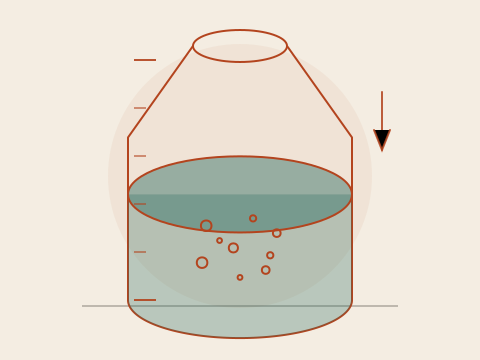
Materials
| Item | Amount | If you do not have it |
|---|---|---|
| Double cream, at least 38% fat | 200 ml, fridge cold | Whipping cream; single cream at 18% fat will not invert |
| Airtight jar | 1, 500 ml, filled no more than halfway | A food processor, which takes about 90 seconds |
| Ice-cold water | 300 ml | Tap water with three ice cubes |
| Fine sieve | 1 | A clean muslin square |
| Salt | 2 g, optional | Nothing; unsalted butter is the honest baseline |
| Thermometer | 1, optional | None; work by feel |
Method
Pour 200 ml of cold cream into the jar and seal it. Check the fat percentage on the carton first.
Watch for: Cream at 38 percent fat is thick enough to coat the jar walls and holds a soft peak.
Shake hard for 60 seconds without stopping. Hand the jar to someone else when your arm tires.
Watch for: The cream thickens, then suddenly stops sloshing: at that point it has become whipped cream and the sound changes.
Keep shaking through the stiff stage. This is the part most people give up on.
Watch for: After another 45 to 90 seconds the mass collapses and you hear and feel liquid rattling in the jar.
Pour off the liquid, add 100 ml of ice-cold water, seal and shake for ten seconds, then pour off again. Repeat twice.
Watch for: The wash water goes from cloudy white to nearly clear as the last of the buttermilk leaves the butter.
Press the butter against the sieve with the back of a spoon to work out the remaining water, then weigh it.
Watch for: From 200 ml of 38 percent cream you should end up with 78 to 84 g of butter plus 110 to 120 ml of buttermilk.
Why it works
Cream is an oil-in-water emulsion: fat droplets stabilised by a phospholipid and protein film, dispersed in a continuous water phase. Shaking delivers mechanical energy that ruptures the films, and because the fat is partly crystallised at fridge temperature, the exposed droplets stick together rather than bouncing apart. Once enough droplets have merged, the fat becomes the continuous phase and the water becomes the droplets. That is a phase inversion, and it is why butter is a solid that holds water rather than a liquid that holds fat. Cold is essential: warm fat stays liquid and the droplets re-coalesce into cream when you stop shaking.
Think of it like: Picture a room full of balloons floating in air. Prick enough of them and the rubber becomes the floor and the air becomes bubbles trapped in it. Nothing was added or removed; the roles of the two phases simply swapped.
Clean-up and disposal
Buttermilk from a home churn is thin and slightly sour; use it in pancakes within three days or discard it. Rinse the jar with hot water and washing-up liquid, because a fat film will survive a cold rinse. Wrap the butter in greaseproof paper and keep it in the fridge for up to two weeks, or freeze it for three months.
Bench notes
Why the jar must be half empty
Headspace is not a detail. A full jar cannot be shaken, and a jar with too much air whips the cream so hard you overshoot into butter before you have watched the transition. Half full, shaken at about four strokes per second, gives you a clean three-stage run.
Observed / 实测From 200 ml of 38 percent cream the timing is roughly 55 seconds to whipped cream, 100 seconds to a grainy mass, and 140 seconds to a clear rattle.
The wash matters more than the shake
Observed / 实测Two cold washes take the butter from about 82 percent fat to about 84 percent, which is the difference between butter that leaks water in a hot pan and butter that browns cleanly.
What to do with the buttermilk
Observed / 实测The buttermilk from a cold churn measures about 1 percent fat and has a pH near 6.6, so it behaves like milk in a batter rather than like the cultured product at pH 4.6.
Variations worth running
- Repeat with cream at 30 percent fat and with 48 percent fat and compare how long the inversion takes and how much buttermilk comes off.
- Leave the jar on the bench for two hours to warm the cream to 20 C before shaking, and see whether the butter sets at all.
- Add 2 g of salt after the first wash and compare how much extra water the salted butter releases overnight.
Questions that come up on the bench
- Why does warm cream refuse to turn into butter?
- Above about 20 C the fat droplets are entirely liquid. They still merge when you shake, but they merge back into droplets as soon as you stop, so you get a temporary thick cream instead of a stable continuous fat phase.
- Is the liquid that comes off real buttermilk?
- Yes, and it is better than the cultured buttermilk sold in cartons for baking. It is thinner and less sour because it has not been fermented, but it leavens and tenderises exactly the same way.
- Can I turn the butter back into cream?
- In principle, yes: warming it and adding the buttermilk back while whisking will re-form an emulsion. In practice the droplet size will be much larger than before and the texture will never be as smooth as the cream you started with.